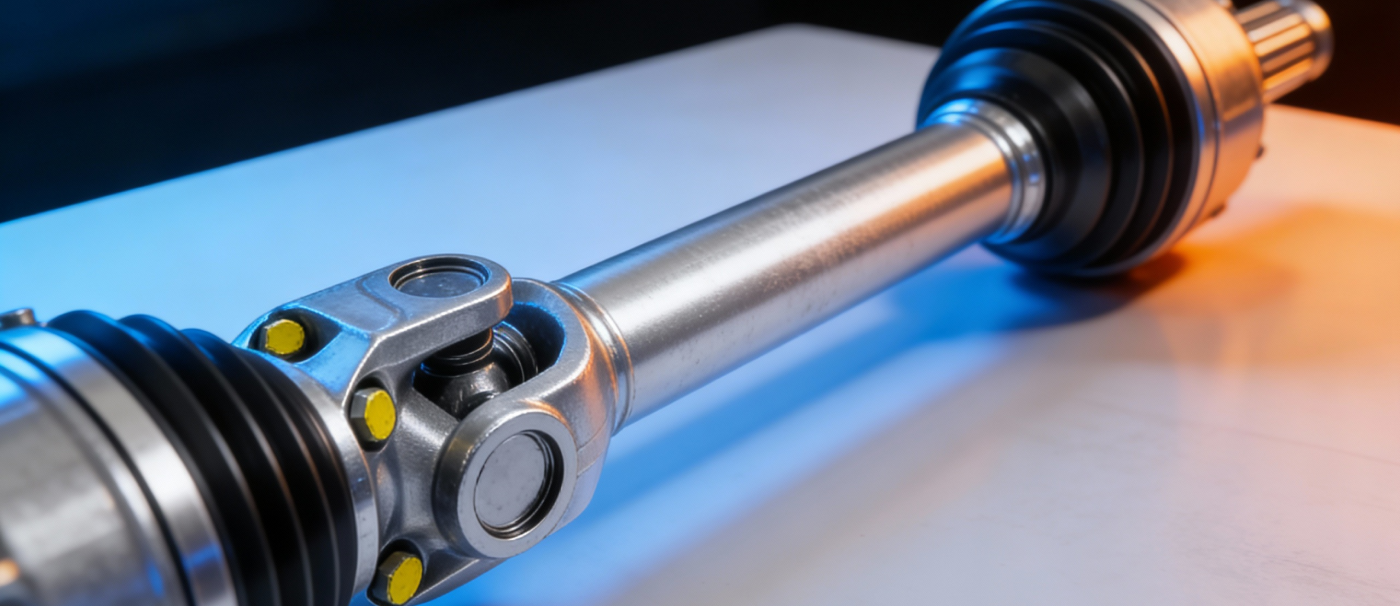




According to non-constant velocity drive shaft manufacturers, quality inspection of drive shaft forgings generally covers three aspects: dimensional accuracy, surface roughness, and geometric & positional accuracy.

(1) Dimensional Accuracy
Manufacturers emphasize that dimensional accuracy is critical for drive shaft components. Although measurement is not highly complex, conventional measuring tools can be used for most features except threads.
Common measuring instruments include:
1.Vernier calipers
2.Micrometers (screw micrometers)
3.Thread micrometers or thread plug gauges for threaded sections
(2) Surface Roughness
For parts with high surface roughness requirements, a surface roughness tester is used.For forgings with relatively low surface roughness requirements (e.g., Ra 0.4 or coarser), a surface roughness comparison specimen block is used for visual comparison.
(3) Geometric and Positional Accuracy
Measurement of geometric and positional accuracy is both important and challenging in machining. Some features can be inspected without specialized instruments, while others require auxiliary tools.1.Geometric Accuracy
2.Geometric accuracy refers to the form of individual features, independent of other points, lines, or surfaces.
Key indicators include:
• Straightness
• Roundness
• Flatness
• Cylindricity
Positional Accuracy
Positional accuracy describes the relationship between two or more features, including 8 main characteristics:
• Parallelism
• Perpendicularity
• Angularity
• Position
• Concentricity
• Symmetry
• Circular runout
• Total runout
Profile tolerances (line profile, surface profile) can apply to either single features or relationships between multiple features.
For drive shafts, the main geometric accuracy requirement is runout of each mating surface.
Common Runout Measurement Methods
1.Bench centers methodMount the forging between centers on a layout/inspection bench, and place the probe of a dial indicator (or a dial test indicator for higher precision) in contact with the measured surface.
Two key precautions:
• The probe must be perpendicular to the measured surface.
• Preload the probe appropriately (normally about 0.2 mm).
2.Lathe centers method
If no inspection bench is available, the forging can be mounted between lathe centers, with measurement steps similar to the first method.
3.V-block method
Support the shaft on a V-block using its reference axis. Use a dial indicator (or dial test indicator) to contact the measured surface, rotate the workpiece, and measure runout relative to the reference axis.
Common Materials for Drive Shaft Forgings
Typical materials include carbon structural steels such as C35, C45, C50, among which C45 (45# steel) is the most widely used.Forging blanks can be selected based on technical requirements and production volume.
Our company manufactures drive shafts in various materials and can produce and machine forgings according to customers’ drawings and specifications. Tel: +86-18838478091
 Email: Joe@hntxcd.com
 Add: South of Changqing Street, Economic and Technological Development Zone, Xuchang City, Henan Province