



Henan Tongxin Transmission Co., Ltd., founded in 2001, is located in the Economic and Technological Development Zone of Xuchang City, Henan Province, covering an area of 80000 square meters. It is a national "specialized, refined, unique, and new" small giant enterprise and a national high-tech enterprise. And officially listed on the Beijing Stock Exchange on November 15, 2021.
The company has its own 'technology center', dedicated to improving product quality and constantly innovating technical processes. With over 40 patented properties, we have pioneered the forging of blank raw materials with "hollow cores and no waste edges" in the industry, and our technology has reached the international priority level. The company relies on advanced production technology, sophisticated equipment, efficient production organization capabilities, strict quality control system, and excellent full-service model; With the quality policy of "pursuing zero defects and satisfying customers", we aim to build our enterprise into a specialized transmission shaft service platform. Adhering to the business philosophy of "seeking profits from products, not from customers", we aim to achieve win-win cooperation with our customers.
The transmission shaft is the shaft in the universal transmission system that can transmit power. It is a high-speed, low support rotating body, so its dynamic balance is crucial. Generally, the transmission shaft needs to undergo a dynamic balancing test before leaving the factory and be adjusted on the balancing machine. For vehicles with front engine and rear wheel drive, the rotation of the transmission is transmitted to the shaft of the main reducer, which can be several joints connected by universal joints.
Introduction
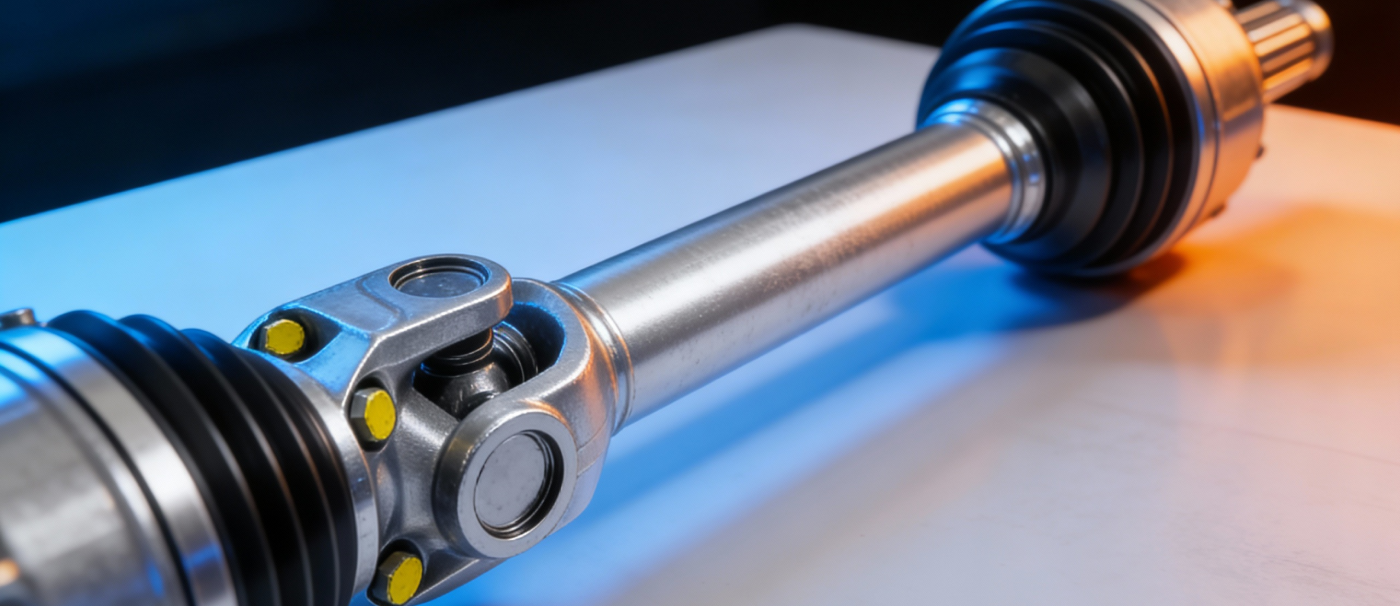
The transmission shaft is composed of a shaft tube, a telescopic sleeve, and a universal joint.
DriveShaft is a circular object accessory that connects or assembles various components and can move or rotate. It is generally made of lightweight and torsion resistant alloy steel pipes. For front engine and rear wheel drive vehicles, it is to transmit the rotation of the transmission to the shaft of the main reducer, which can be connected by several universal joints. It is a high-speed, low support rotating body, so its dynamic balance is crucial. Generally, the transmission shaft needs to undergo a dynamic balancing test before leaving the factory and be adjusted on the balancing machine.
The drive shaft is an important component in the automotive transmission system that transmits power. Its function is to work together with the gearbox and drive axle to transfer the engine's power to the wheels, generating driving force for the car.
Special purpose vehicle transmission shafts are mainly used in oil tanker trucks, refueling trucks, sprinkler trucks, sewage suction trucks, fecal suction trucks, fire trucks, high-pressure cleaning trucks, road clearing trucks, aerial work vehicles, garbage trucks and other vehicle models.
The transmission shaft is composed of a shaft tube, a telescopic sleeve, and a universal joint. The telescopic sleeve can automatically adjust the distance between the transmission and the drive axle. The universal joint ensures the variation of the angle between the output shaft of the transmission and the input shaft of the drive axle, and achieves equal angular velocity transmission between the two shafts.
The universal joint is a key component on the transmission shaft of a car. A car is a moving object. On rear drive vehicles, the engine, clutch, and transmission are installed as a whole on the frame, while the drive axle is connected to the frame through elastic suspension, with a distance between them that needs to be connected. Uneven road surfaces cause bouncing during car operation.
1. Function:
Generally, universal joints are composed of cross shafts, cross bearings, and flange forks. The universal joint is a key component on the transmission shaft of a car. On vehicles with front engine and rear wheel drive, the universal joint drive shaft is installed between the transmission output shaft and the drive axle main reducer input shaft; Vehicles with front engine and front wheel drive omit the transmission shaft, and universal joints are installed between the front axle half shaft, which is responsible for both driving and steering, and the wheels. Uneven road surfaces, load changes, or differences in the installation positions of two assemblies during vehicle operation can cause variations in the angle and distance between the transmission output shaft and the drive axle main reducer input shaft. Therefore, a "variable strain" device is needed to solve this problem, hence the universal joint.
2. Transmission characteristics:
In front engine rear wheel drive (or all wheel drive) vehicles, due to suspension deformation during movement, there is often relative motion between the input shaft of the drive shaft, main reducer, and the output shaft of the transmission (or transfer case). In addition, to effectively avoid certain mechanisms or devices (which cannot achieve linear transmission), there must be a device to achieve normal power transmission, hence the emergence of universal joint transmission. Universal joint transmission must have the following characteristics:
a 、 Ensure reliable transmission of power when the relative position of the two connected shafts changes within the expected range;
b 、 Ensure that the two connected shafts can operate uniformly. The additional load, vibration, and noise generated by the angle of the universal joint should be within the allowable range;
c 、 High transmission efficiency, long service life, simple structure, easy manufacturing, and easy maintenance are required. For automobiles, since the output shaft of a cross shaft universal joint rotates at different speeds relative to the input shaft (with a certain included angle), it is necessary to adopt double universal joints (or multiple universal joints) for transmission, and arrange two universal joint forks connected to the transmission shaft on the same plane, so that the included angles of the two universal joints are equal. This is very important. During design, the angle of the universal joint should be minimized as much as possible.
Telescopic sleeve
The traditional structure of the transmission shaft expansion sleeve is to weld the spline sleeve and the flange fork together, and weld the spline shaft to the transmission shaft tube. The new type of transmission shaft changes the traditional structure by welding the spline sleeve and transmission shaft tube together, Integrate the spline shaft with the flange fork. And change the rectangular tooth spline to a high pressure angle in volute short tooth spline, which not only increases strength but also facilitates extrusion forming, adapting to the needs of high torque working conditions. On the surface of the teeth of the expansion sleeve and spline shaft, a layer of nylon material is applied as a whole, which not only increases wear resistance and self-lubricating properties, but also reduces the damage of impact load to the transmission shaft and improves the buffering capacity.
This type of transmission shaft adds a tubular sealing protective sleeve outside the flange spline shaft, and two polyurethane rubber oil seals are set at the end of the protective sleeve, creating a completely sealed space inside the expansion sleeve, preventing the expansion spline shaft from being eroded by external dust, not only dustproof but also rust proof. Therefore, applying lubricating grease to the spline shaft and sleeve at once during assembly can fully meet the usage requirements, without the need for oil nozzle lubrication, reducing maintenance content.
It is designed to reduce friction and wear during shaft movement, and its basic use is no different from bearings. It is relatively inexpensive, but it has high friction resistance, so it will only be used on some components. Most shaft sleeves are made of copper, but there are also plastic shaft sleeves. The shaft sleeve is often placed in the shaft and supporting structure, and is very close to the supporting structure, only the shaft can rotate on the shaft sleeve. When assembling the shaft and sleeve, lubricant is added between them to reduce the friction generated during rotation.
According to elasticity score
Transmission shafts can be classified differently based on their important components - universal joints. If there is obvious elasticity in the direction of torsion of the universal joint, it can be divided into rigid universal joint transmission shaft and flexible universal joint transmission shaft.
1. Rigid universal joint: It transmits power through hinge type connections of components.
2. Flexible universal joint: It transmits power through elastic parts and has a buffering and vibration reducing effect.
Divided by angular velocity
Rigid universal joints can be divided into non constant velocity universal joints (such as cross axis universal joints), quasi constant velocity universal joints (such as double joint universal joints, three pin axis universal joints), and constant velocity universal joints (such as ball cage universal joints, ball fork universal joints). Constant speed and non-uniform speed refer to whether the rotational angular velocity of the driven shaft is equal when it rotates with the driving shaft. Of course, the average rotational speed of the driving shaft and the driven shaft is equal.
1. Constant velocity universal joint:
A universal joint in which the angular velocity of the main and driven shafts remains equal when the angle between the two shafts changes is called a constant velocity universal joint or an equal angular velocity universal joint. They are mainly used in wheel transmission devices such as steering drive axles and disconnect drive axles, and are mainly used for power transmission in cars.
2. Non constant velocity universal joint:
The universal joint in which the angular velocity of the main and driven shafts varies at different angles between the two shafts is called an unequal velocity universal joint, also known as a cross axis universal joint.
The cross axis rigid universal joint transmission shaft is the most widely used and has the longest history in automotive transmission systems. When a sedan is rear wheel drive, a cross axis universal joint transmission shaft is often used, and for some high-end sedans, a constant velocity ball joint is also used; When a sedan is front wheel drive, a constant velocity universal joint is often used - the constant velocity universal joint is also a type of transmission shaft, just called differently. The transmission shaft usually refers to a cross axis rigid universal joint transmission shaft. The cross axis rigid universal joint is mainly used to transmit changes in angle, and is generally composed of flange forks, cross axis needle roller bearing assemblies, universal joint forks or sliding forks, intermediate connecting forks or spline shaft forks, axial fixing parts of needle roller bearings, etc.
A flange fork is a fork shaped component with a flange, generally made of forged medium carbon steel or medium carbon alloy steel, as well as sand castings made of ductile iron and precision castings made of medium carbon steel or high-quality medium carbon alloy steel. The flange fork usually comes with a flat flange, but there are also those with a trapezoidal toothed flange on the end face. The cross shaft with needle roller bearing assembly generally includes four needle roller bearings, one cross shaft, and one grease nozzle. Needle roller bearings generally consist of several needle rollers, a bearing bowl, and a multi blade rubber oil seal (partially with a skeleton). In some needle roller bearings, there is also a circular gasket with an oil groove, which is made of nylon, copper or other materials, mainly used to reduce the axial clearance of the universal joint and improve the dynamic balance quality of the transmission shaft. The universal joint fork is a fork shaped component, usually forged from medium carbon steel or medium carbon alloy steel, but also precision cast from medium carbon steel. The axial fixing parts of needle roller bearings are generally holes (or shafts) with elastic retaining rings (inner and outer card type), or bearing pressure plates, locking plates, bolts, etc.
Divided by transmitted torque
Micro car transmission shaft
Light vehicle transmission shaft
Medium sized car transmission shaft
Heavy duty vehicle transmission shaft
Engineering vehicle transmission shaft
Henan Tongxin Transmission Co., Ltd., founded in 2001, is located in the Economic and Technological Development Zone of Xuchang City, Henan Province, covering an area of 80000 square meters. It is a national "specialized, refined, unique, and new" small giant enterprise and a national high-tech enterprise. And officially listed on the Beijing Stock Exchange on November 15, 2021.
The company has its own 'technology center', dedicated to improving product quality and constantly innovating technical processes. With over 40 patented properties, we have pioneered the forging of blank raw materials with "hollow cores and no waste edges" in the industry, and our technology has reached the international priority level. The company relies on advanced production technology, sophisticated equipment, efficient production organization capabilities, strict quality control system, and excellent full-service model; With the quality policy of "pursuing zero defects and satisfying customers", we aim to build our enterprise into a specialized transmission shaft service platform. Adhering to the business philosophy of "seeking profits from products, not from customers", we aim to achieve win-win cooperation with our customers.

 Tel: +86-18838478091
 Email: Joe@hntxcd.com
 Add: South of Changqing Street, Economic and Technological Development Zone, Xuchang City, Henan Province