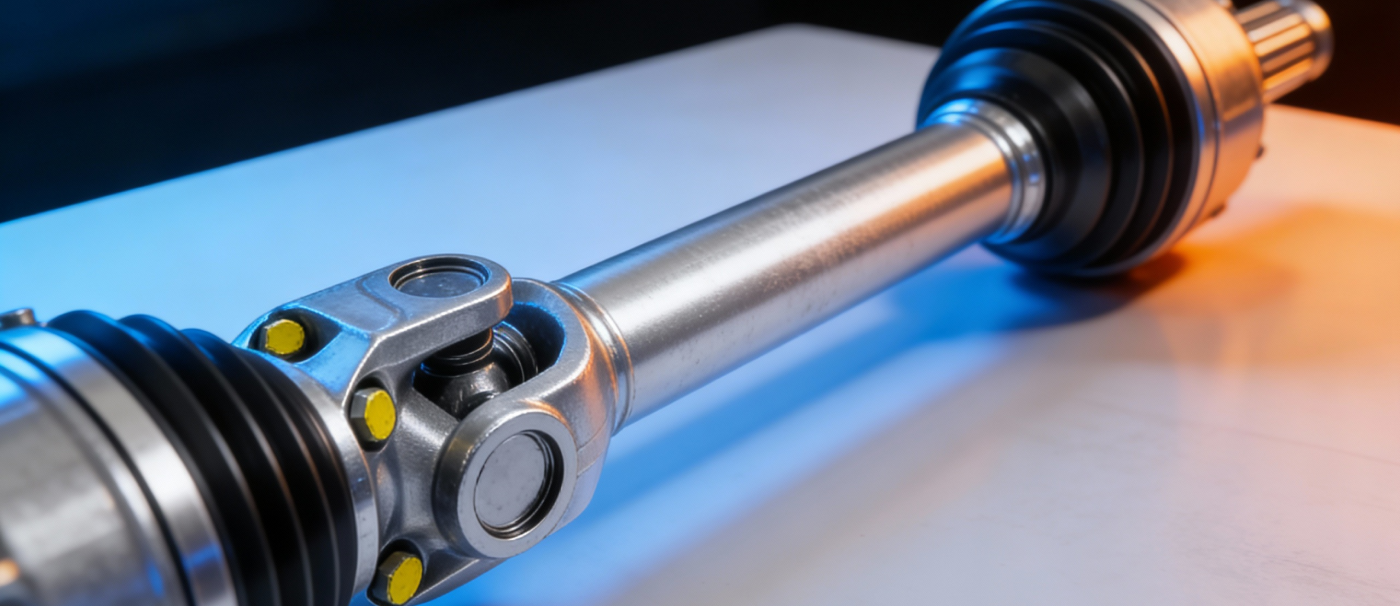




According to the non-constant velocity drive shaft manufacturer, a coupling, also known as a shaft coupling, is a mechanical component used to rigidly connect the driving shaft and driven shaft in different mechanisms so that they rotate together to transmit motion and torque. It is sometimes also used to connect shafts with other components (such as gears, pulleys, etc.). It usually consists of two halves, each connected by keys or interference fit, fastened to the two shaft ends, and then joined together by certain means.
Couplings can compensate for misalignment between two shafts caused by inaccuracies in manufacturing and installation, deformation during operation, thermal expansion, and other factors, while also absorbing shock and vibration.
Most commonly used couplings from non-constant velocity drive shaft manufacturers have been standardized or normalized. Generally, it is only necessary to select the proper type of coupling and determine its type and size. However, as you may know, there are many types of couplings, each with different functions and features. A brief introduction is given below:
Features of Chain Couplings (from non-constant velocity drive shaft manufacturer): Chain couplings offer a certain degree of misalignment compensation, but cannot dampen vibration or absorb shock, so they are not suitable for shaft drives with impact and vibration loads. This type of coupling belongs to the category of flexible couplings without elastic elements.
Flexible couplings without elastic elements include: slider couplings, chain couplings, gear couplings, universal couplings, spherical roller couplings, ball couplings, steel ball couplings, etc.
A chain coupling uses a double-row roller chain to engage with two identical parallel sprockets simultaneously, achieving connection between the two coupling halves. The main difference among various types of chain couplings lies in the chains used, such as double-row roller chain couplings, single-row roller chain couplings, silent chain couplings, nylon chain couplings, etc.
Although all couplings require constant RPM transmission, not all can meet the strict requirements of motion control, where two shafts must move at the same speed and reach the same position to maintain synchronization. Such applications include shaft encoders, resolvers, various servo devices, linear and ball screw actuators, robots, stepper motors, optical pumps, metering equipment, plotters, medical devices, positioning stages, computers, radar, and other equipment.
For motion control, important coupling characteristics include high torsional stiffness, low radial stiffness, low inertia, constant velocity rotation, no wrap-up, zero backlash between coupling components, shaft interface compatibility, and corrosion resistance.
High-precision machine tools, robotic systems, printing presses, and encoders all require extremely stiff couplings, with encoders providing position feedback for the system.
The torsional stiffness of a coupling is generally related to the torque used in the system, rather than the performance of the coupling itself. Light-duty couplings can perform similarly to highly rigid ones, but this usually means they are oversized. Such over-sizing effects are often seen when low-backlash curved jaw couplings are used in motion control applications.
 Tel: +86-18838478091
 Email: Joe@hntxcd.com
 Add: South of Changqing Street, Economic and Technological Development Zone, Xuchang City, Henan Province