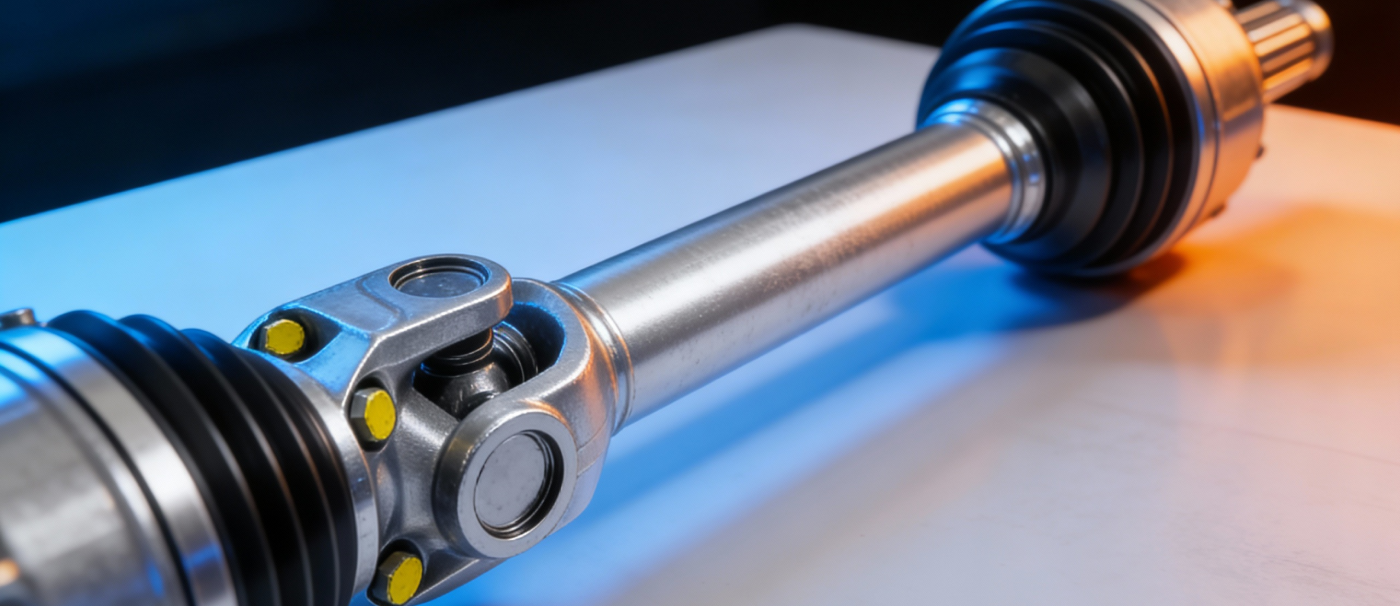




The drive shaft is one of the key components of machinery. Its primary functions are to transmit motion and torque, as well as to support rotating parts. According to different load types, shafts can be classified into center shafts, spindle shafts, and drive shafts. Generally, drive shafts have relatively high requirements for dynamic balance, weight, corrosion resistance, fatigue resistance, as well as for materials and processing technologies. In the following, the non-constant velocity drive shaft manufacturer shares the advantages and market applications of carbon fiber drive shafts.
Torsional strength and torsional fatigue life are two important performance indicators of drive shafts. The longitudinal tensile strength of carbon fiber composite material is about 20 times that of its transverse tensile strength, and its longitudinal elastic modulus is about 14 times that of its transverse elastic modulus. Rational structural design can maximize the torsional strength of carbon fiber composite drive shafts and significantly improve their torsional fatigue strength.
At present, according to non-constant velocity drive shaft manufacturers, many foreign automobiles have begun to adopt carbon fiber composite drive shafts. Compared with metal drive shafts, carbon fiber composite automotive drive shafts reduce weight, simplify the structure, and lower vibration and noise.
In addition to automobiles, carbon fiber composite drive shafts are also used in machinery, ships and other equipment. Carbon fiber composite drive shafts feature light weight, high natural frequency and low moment of inertia. When applied in machine tools, they can not only increase spindle speed, but also greatly reduce the impact of rapid direction changes on the machine tool, thus extending service life and improving machining accuracy. Due to their light weight, carbon fiber drive shafts require fewer intermediate supports and can be widely used in ships.
When carbon fiber prepreg layers are oriented at approximately 0°, 45° and 90°, the torsional strength of the structural component is relatively high. Torsional strength increases with the wall thickness of the component. Adding 40 to 70 layers can improve the torsional stiffness of parts. Symmetrical layup is more beneficial for parts to withstand torque than asymmetrical layup. Carbon fiber drive shafts offer better motion stability and smaller main resonance amplitude than steel or aluminum alloy drive shafts. In addition, compared with metal drive shafts, carbon fiber drive shafts are about 50% lighter, reducing manufacturing costs and improving reliability.
Structure and Manufacturing Characteristics of Carbon Fiber Drive Shafts
Materials such as resin and curing agent are mixed in a certain proportion, then used to impregnate carbon fiber fabric. After a series of curing processes, carbon fiber composite material is formed – the black grid-pattern material often seen on automobiles. Although it does not look like plastic, this material possesses advantages unmatched by traditional metals.
However, according to non-constant velocity drive shaft manufacturers, such carbon fiber drive shafts are not entirely made of carbon fiber. A metal mesh structure is first used as the drive shaft core skeleton, and then carbon fiber with a total length of more than 100 meters is spirally wound around the metal skeleton. Carbon fiber tows have extremely high tensile strength. When spirally wound into a “rod-shaped” carbon fiber shaft, they convert torsional load into tensile force along the carbon fiber filaments, thereby giving full play to the high strength of carbon fiber.
 Tel: +86-18838478091
 Email: Joe@hntxcd.com
 Add: South of Changqing Street, Economic and Technological Development Zone, Xuchang City, Henan Province