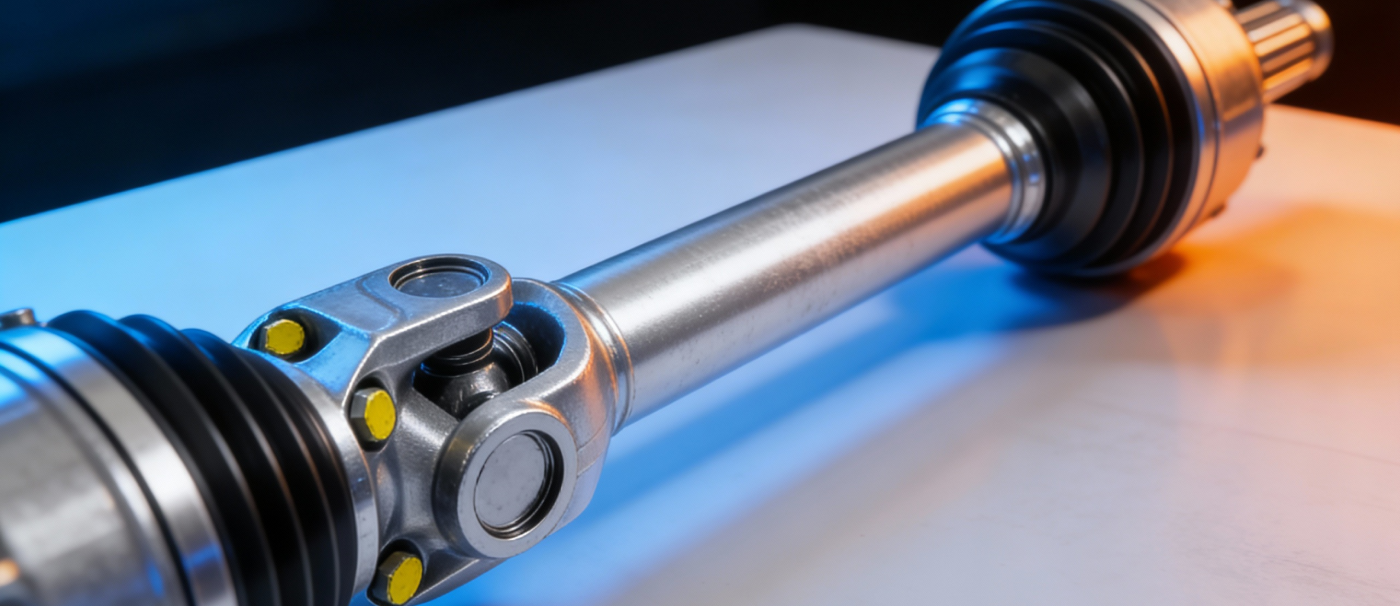




According to the universal coupling manufacturer, a coupling is typically used to connect two shafts, transmitting motion and torque between them. It can absorb vibration, reduce impact, and act as a safety device to prevent connected components from bearing excessive loads, thus providing overload protection. When shafts are connected, they can only be separated after the machine is shut down and the coupling is disassembled.

Rigid Coupling: Requires strict alignment of the centerlines of the two connected shafts.
Flexible Coupling: Allows for a certain degree of installation error between the two shafts.
Elastic Coupling: Features elastic elements made of various materials, capable of compensating for displacements between two shafts within a certain range, as well as providing buffering and vibration damping functions.
The universal coupling manufacturer notes that due to manufacturing and installation errors, deformation under load, bearing wear, imbalance of rotating parts, and temperature changes, the axes of two shafts often have a certain degree of relative displacement and deflection.
Corresponding structural measures should be adopted to enable the coupling to compensate for various deviations; otherwise, additional loads will be imposed on the design of shafts, couplings, and bearings, leading to deteriorated operating conditions. The types of displacement between two shafts include: axial displacement, radial displacement, angular displacement, and combined displacement.
Couplings are available in numerous types, models, and specifications. On the basis of correctly understanding the respective concepts of type, model, and specification, the appropriate coupling should be selected according to transmission requirements. Firstly, selection should be made from couplings that have been standardized. Currently, there are dozens of industry standards for couplings formulated in China. Most of these standard couplings are universal couplings and cardan shafts, each with distinct characteristics and application scopes, which can basically meet the needs of various operating conditions. Generally, designers do not need to develop their own couplings. Standard couplings are easy to purchase and much more cost-effective than custom-designed non-standard ones.
Among the various standard couplings, selecting the one that suits specific needs is crucial to a series of factors such as operational performance, reliability, service life, vibration, noise, energy efficiency, transmission efficiency, transmission accuracy, and economy, as well as the quality of mechanical products. When choosing a coupling, designers should consider the angle and requirements of shafting transmission, avoiding a simplistic focus on the connection between the driving and driven ends.
The allowable speed range of a coupling is determined by calculating the allowable linear speed of the coupling's material and its outer dimensions. Couplings of different materials, types, and specifications have different allowable speed ranges. Changing the coupling material can expand its allowable speed range – the allowable speed of steel couplings is higher than that of cast iron ones.
 Tel: +86-18838478091
 Email: Joe@hntxcd.com
 Add: South of Changqing Street, Economic and Technological Development Zone, Xuchang City, Henan Province