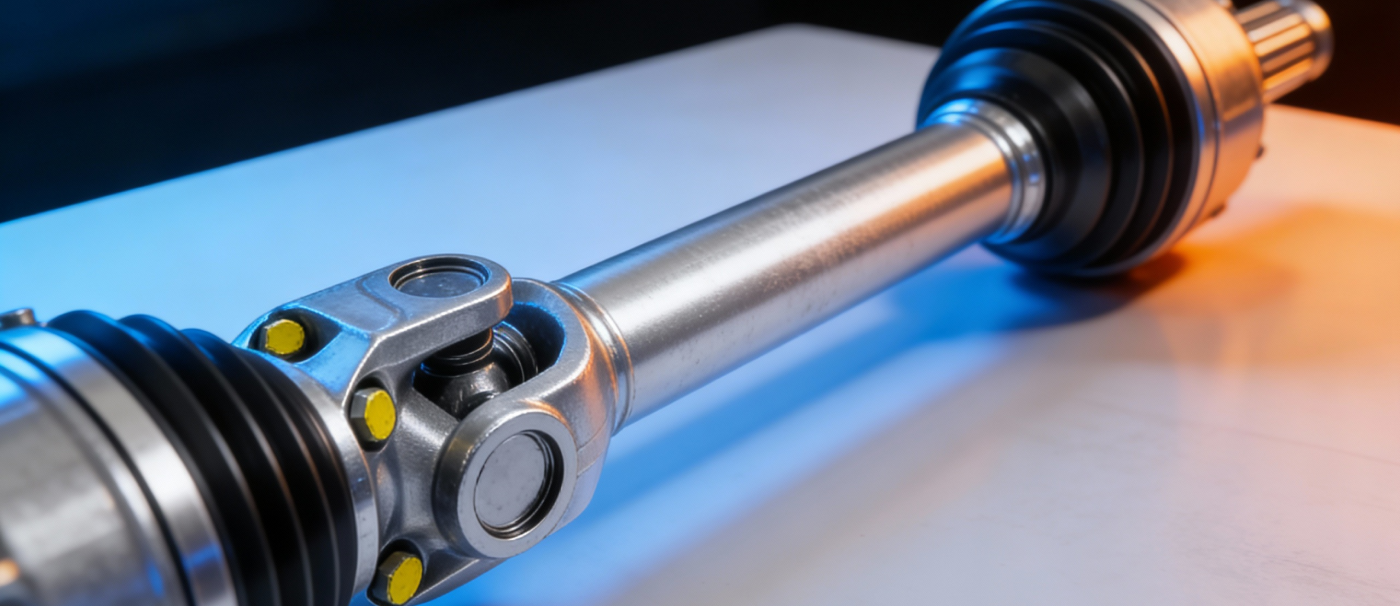




The component shown is a drive shaft for a reducer. As noted by manufacturers of non‑constant velocity drive shafts, shaft parts are among the most common components in machinery.

Based on structure, shafts can be classified into three types: straight shafts, stepped shafts, and special-shaped shafts. They can also be categorized as solid shafts or hollow shafts.
Among these, the machining process of stepped shafts is highly representative, reflecting most of the key content and basic principles of shaft machining.
1. Part Structure Analysis (from Non‑Constant Velocity Drive Shaft Manufacturers)
The component shown is a reducer drive shaft, which belongs to the category of stepped shafts. It consists of cylindrical surfaces, shoulders, threads, thread undercuts, wheel cross grooves, keyways, and other features.
Shaft shoulders are typically used to axially locate parts mounted on the shaft.
Each annular groove provides proper positioning during assembly and facilitates tool retraction when grinding external circles or cutting external threads.
Keyways are used to install keys for torque transmission.
Threads are used to install various lock nuts and adjusting nuts.
According to working performance and service conditions, the main journals M and N, external circles P and Q, and shaft shoulders G, H, and I (as shown in Drawing A‑1) have strict requirements for dimensional accuracy, positional accuracy, surface roughness, and heat treatment. These technical specifications must be guaranteed during machining.
2. Determination of the Blank
The material of this drive shaft is 45# carbon steel, which is a common grade for general drive shafts and fully meets performance requirements.
Since this drive shaft is a small‑to‑medium size shaft with relatively small differences in external diameters, hot‑rolled round steel with a diameter of 60 mm is selected as the blank.
3. Selection of Main Surface Machining Methods
Most features of the drive shaft are rotating surfaces, which are mainly formed by turning and external cylindrical grinding.
Given the high requirement for surface roughness (Ra = 0.8 μm), grinding must be performed after turning.
The recommended process sequence for external cylindrical surfaces (refer to Table A‑3) is:
Rough turning → Semi‑finishing turning → Grinding
4. Machining Stage Classification
For high‑precision components, machining must be divided into roughing and finishing stages to ensure dimensional stability and quality.
The machining of this drive shaft is divided into three stages:
Rough machining: rough turning of external surfaces, drilling center holes, etc.
Semi‑finishing machining: semi‑finishing turning of external surfaces and steps, finishing center holes, machining auxiliary surfaces, etc.
Finishing & grinding: finish turning and grinding of external surfaces.
5. Heat Treatment Process Arrangement
Heat treatment for shafts depends on material and service requirements. Common treatments for drive shafts include normalizing, quenching and tempering, and surface hardening.
This shaft requires quenching and tempering (hardening and tempering), which is scheduled:
After rough turning of all external surfaces and before semi‑finishing turning.
6. Machining Dimensions and Cutting Parameters
The machining allowances are determined as follows:
Grinding allowance: 0.5 mm
Semi‑finishing turning allowance: 1.5 mm
Machining dimensions can be calculated accordingly. For details, refer to the process sheet for this shaft.
When formulating the process flow, manufacturers of non‑constant velocity drive shafts emphasize that consideration must be given to the arrangement of inspection steps, inspection items, and corresponding inspection methods.
 Tel: +86-18838478091
 Email: Joe@hntxcd.com
 Add: South of Changqing Street, Economic and Technological Development Zone, Xuchang City, Henan Province