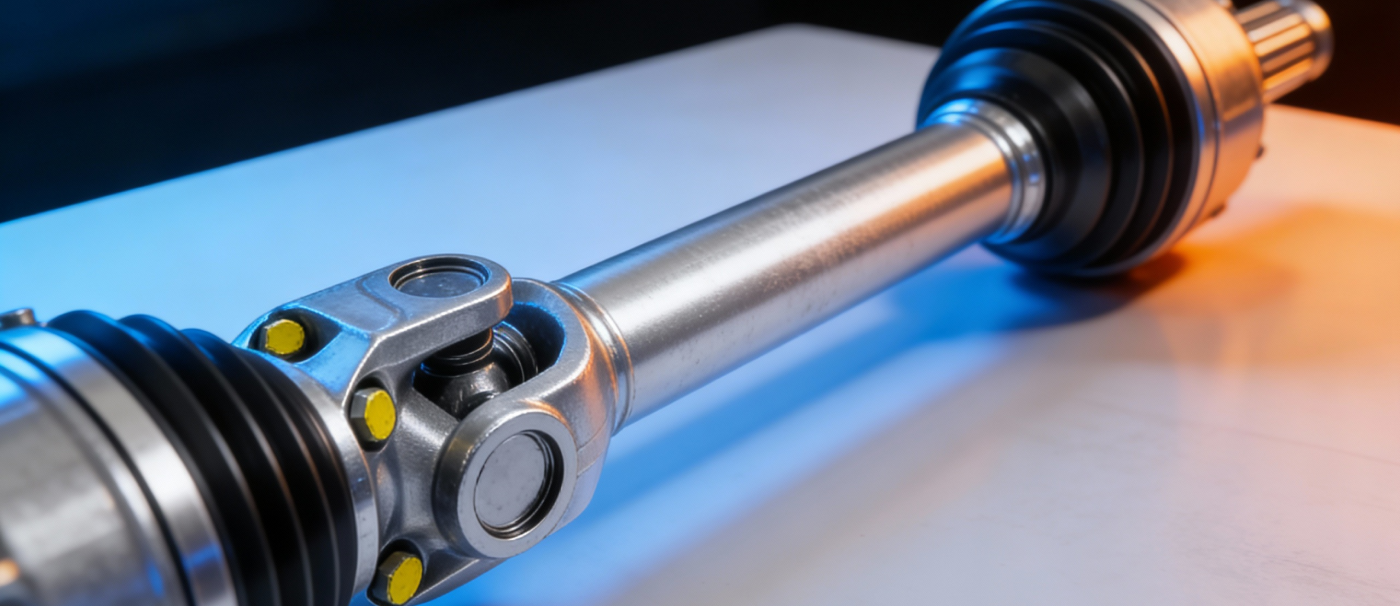




According to the current trend of standard load transportation, although profit margins have narrowed, vehicle wear and tear has decreased. Many users used to overload integrated drive shafts, causing torsional deformation. Under standard load conditions, the failure rate of integrated drive shafts has dropped and service life has improved, but some minor issues still exist and require attention and proper maintenance from vehicle managers.
Fault 1: Looseness and Excessive Noise of Integrated Drive Shaft
When the vehicle starts under heavy load or accelerates with heavy throttle, the integrated drive shaft emits a “clanking” metal impact sound, and visible looseness can be observed. After eliminating looseness in the rear axle bevel gear and spur gear, maintenance personnel can focus on checking looseness in the integrated drive shaft and conduct repairs using elimination methods.
Based on structural analysis, the loose components are usually the universal joint cross shafts. Since the middle section is a solid steel rod, problems other than torsional deformation rarely occur. The main issues lie in the cross shaft and the sliding sleeve.
According to maintenance standards:
- • The fitting clearance between the splined shaft and splined sleeve of the sliding assembly should be no more than 0.3 mm.
- • The looseness between the cross shaft and bearings should be no more than 0.15 mm.
Fault 2: Loosening or Loss of Connecting Bolts
A braking failure mentioned earlier was caused by the loss of connecting bolts, which led to loss of control of the integrated drive shaft. The front section rotated with the gearbox, resulting in severe mechanical damage.
Loss of connecting bolts is common in heavy-duty vehicles, with many possible causes. The root cause is often difficult to identify, so regular inspection and maintenance are essential.
Typical main causes include:
- • Bending or unbalanced dynamic balance of the drive shaft, causing severe vibration during operation and loosening the bolts.
- • Insufficient torque during bolt tightening, leading to gradual loosening and falling off after prolonged rotation.
- • Sudden heavy load impact or improper assembly, resulting in loose connections.
After replacement or repair, attention must be paid to the dynamic balance of the integrated drive shaft to ensure it meets operating accuracy requirements. If the two lugs on the mounting shaft are misaligned, the cross shafts of the universal joints at both ends will not lie in the same plane, resulting in non-uniform rotation and frequent failures. Note that the drive shaft is not a horizontally mounted component; there is an angular offset between the transmission and the rear axle.
Fault 3: Vehicle Vibration
A heavy-duty truck experienced severe vibration of the integrated drive shaft at a high speed of 80 km/h. The vibration disappeared after decelerating, a common issue across many vehicles, sometimes regarded as a persistent problem that even experienced technicians struggle to resolve. In principle, this may relate to design factors.
Vibration typically occurs if the drive shaft is bent, twisted, or dynamically unbalanced. The higher the speed, the more obvious the vibration, which can even be felt through the steering wheel. The vibration diminishes when vehicle speed decreases. Analysis of the critical speed design suggests the set value may be too low, or bending of the integrated drive shaft has destroyed its dynamic balance.
 Tel: +86-18838478091
 Email: Joe@hntxcd.com
 Add: South of Changqing Street, Economic and Technological Development Zone, Xuchang City, Henan Province